Today: The Cincinnati Reds have made headlines by officially announcing their contract extension with pitcher Chase Burns.
Recent Developments: On July 16, it was confirmed that the Reds and right-handed pitcher Chase Burns agreed on a seven-year deal worth $105 million, as first reported by Jon Morosi of MLB Network. Presently under arbitration control through the 2031 season, this new agreement kicks off next year and stretches through 2033. Notably, it contains no deferred money or option years, granting the team an additional two years of club control over the former No. 2 overall draft pick.
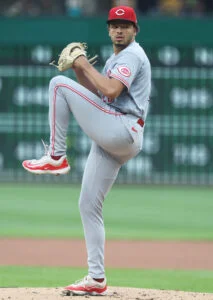
At just 23 years old, Burns has already established himself as one of the more dominant pitchers in the league. He has made 18 starts this season, logging a total of 102.2 innings and posting an impressive 2.54 earned run average. His strikeout rate stands at 28.6%, while his walk rate is a modest 9%. As a fly-ball pitcher in a home run-friendly ballpark, he has effectively minimized hard contact, allowing only 1.05 homers per nine innings pitched.
Burns, standing tall at 6’3” and weighing 210 pounds, possesses the ideal frame for a starting pitcher. His pitch arsenal includes a blazing four-seam fastball averaging 97.8 mph, complemented by a nasty slider at 90.5 mph, and a rarely used changeup thrown at a mere 5.7% clip. His ability to get hitters to chase adds to his effectiveness, with nearly 34% of opposing batters swinging at pitches outside the strike zone. The contact rate against him (71%) is significantly lower than the league average of 77%, and his swinging-strike rate of 14.1% exceeds the norm by three percentage points. Clearly, hitters struggle to make solid contact against him.
Burns’ primary pitches—a four-seamer and a slider—are highly effective. While his changeup could benefit from improvement to keep left-handed hitters off balance, he has managed to limit damage against them. They have a combined line of .214/.307/.409 against him, and despite giving up 10 of his 12 home runs to lefties, left-handed batters aren't posing a significant threat. Right-handed hitters, however, have fared even worse, managing just a .195/.230/.286 line over 161 plate appearances this season.
The Reds drafted Burns with the second overall pick in 2024, and he quickly transitioned to the majors, making his debut just under a year later on June 24, 2025. While his initial season was mixed—posting a 4.57 ERA with a notable 35.6% strikeout rate in 43.1 innings—signs of his potential were evident. In relief appearances, he managed to close out the 2025 season with just three earned runs and an impressive 22-to-4 strikeout-to-walk ratio during his last 16 innings.
This contract extension for Burns is noteworthy, as it represents the largest ever for a pitcher with fewer than four years of major league service time. Historically, the trend has leaned towards rewarding position players with significant long-term deals, while young pitchers are typically offered less lucrative contracts. To illustrate, top position prospects like Colt Emerson ($95 million), Konnor Griffin ($140 million), and Kevin McGonigle ($150 million) received significant contracts recently without major league experience. Prior to Burns' extension, Logan Webb held the record for a pitcher in this category, signing a five-year, $90 million deal in April 2023.
With this new commitment, Burns pairs with another top-tier pitcher, Hunter Greene, who was also drafted second overall by the Reds—albeit seven years earlier. Greene, who faced surgery earlier this season but has been a standout in his first two seasons, has become an imposing presence alongside Burns. Although Greene's 2023 season has been limited, he still boasts a track record of 258 innings pitched with a 2.76 ERA across 2024-25.
If both Burns and Greene can maintain their health, they represent one of the more formidable one-two pitching duos in MLB. The Reds have additional young arms, such as Andrew Abbott, Nick Lodolo, Rhett Lowder, and Chase Petty, who provide promising depth, all under team control beyond the 2026 season.
As the Reds currently sit at nine games below .500 and in last place in the NL Central, questions about how the front office will approach potential trades loom. Players like Abbott and Lodolo could certainly be on the radar as teams look to reshape their rosters during the upcoming months.
Financially, the Reds had maintained a surprisingly lean payroll going into next season without many contract obligations. Prior to the Burns extension, only three players had guaranteed contracts totaling $27.25 million. As another endorsement of team strategy, the financial commitment for Burns aligns closely with a typical development curve for young pitchers, ensuring manageable costs without significant strain on their budget.
In many ways, this extension represents a consensus win among stakeholders. While Burns might have aimed for greater financial security through arbitration and free agency, the inherent risks of declining performance or injury make this long-term deal appealing. For the Reds, securing Burns for his prime years allows them to potentially capitalize on his talent while setting him up for future free agency ahead of his age-31 season.